

Record Demand, Declining Construction: The Grid Bottleneck Reshaping America’s Data Center Map
The U.S. data center industry just posted its first construction decline since 2020 — not because demand faltered, but because the grid finally said no.

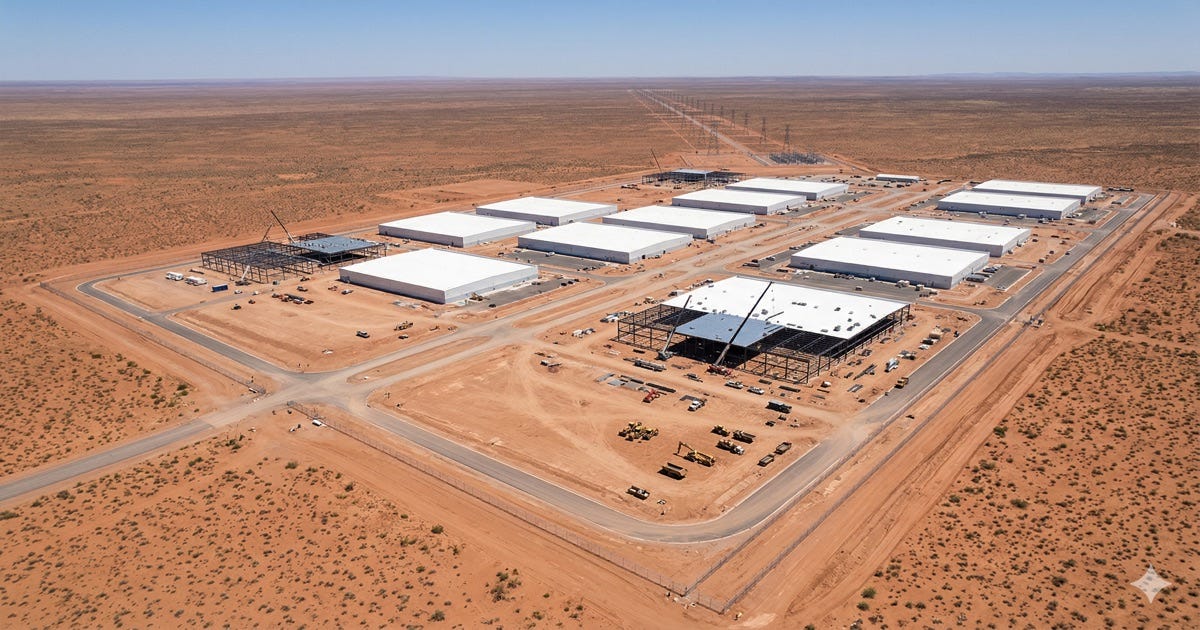
The numbers from Q4 2025 don’t make sense on the surface. Data center demand hit an all-time high. Vacancy fell to a historic low of 1.4%.3 Net absorption set a record at 2,498 megawatts (MW).3 Supply grew 36% year-over-year to 9,432 MW, and demand still outpaced it.3
And yet: the amount of new capacity added to the U.S. data center pipeline dropped 50% in Q4 2025 compared to Q3.1 Under-construction capacity across primary markets fell 6% year-over-year to 5,994 MW — the first decline since 2020.3 New pipeline additions are slowing. Developer capex growth is expected to drop to 58% of its 2025 rate.1
This is not a cyclical correction. It’s not AI hype collapsing. The hyperscalers are still spending — $602 billion in combined capex projected for 2026, up 36% from 2025.8 Amazon alone is committing $200 billion. The money is there. The megawatts are not.
What happened in Q4 2025 is the first visible market evidence that the data center buildout has collided with a hard physical constraint: grid capacity. Sites that could be built with land and capital alone — there are plenty of those. Sites that can actually get power within a reasonable timeline — those are now the scarcest resource in the American economy.
The implications ripple outward in ways that matter directly to energy investors, infrastructure developers, and utility strategists. The bottleneck has shifted, and the investment thesis has to shift with it.
Record Demand Meets the Grid’s Hard Ceiling
The 2025 U.S. data center market was, by every traditional metric, spectacular. The sector delivered 9,432 MW of new supply — up 36% from 2024.3 Net absorption of 2,498 MW broke the previous record set just one year prior.3 Vacancy hit 1.4%, a level so tight it would signal distress in any other asset class.3
Then Q4 arrived, and the pipeline data told a different story.
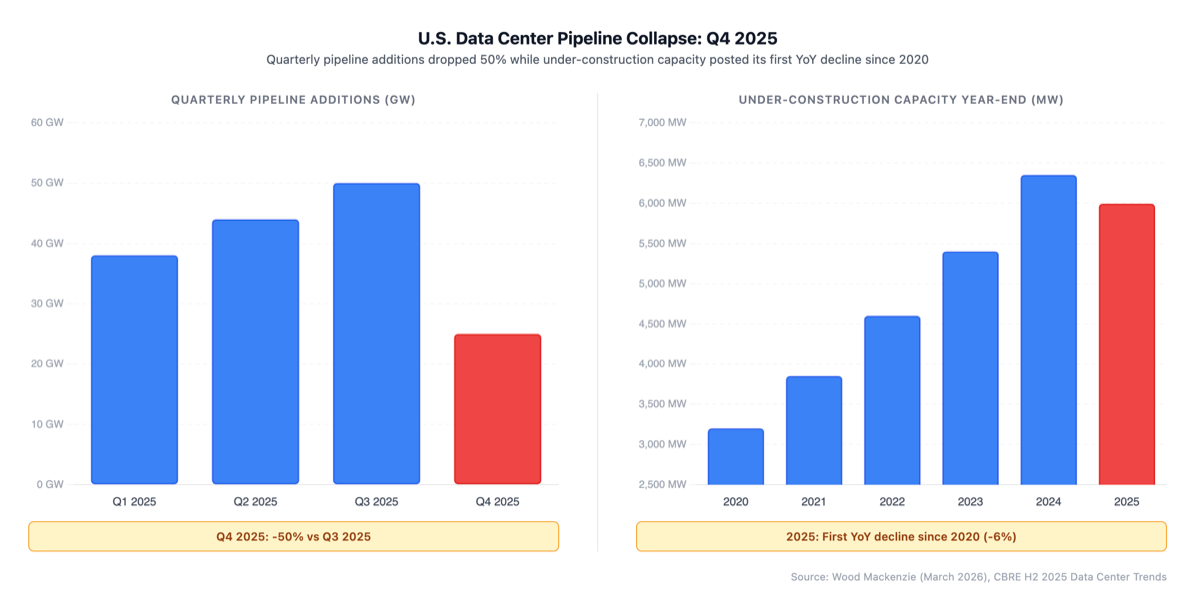
Wood Mackenzie’s March 2026 analysis found that newly added U.S. data center pipeline capacity fell to 25 gigawatts (GW) in Q4 2025 — half the Q3 volume.1 The total disclosed pipeline stands at 241 GW, with only 33% under active development.1 Sightline Climate, tracking 777 large data centers (greater than 50 MW) announced since 2024, found 30 to 50% of the 2026 pipeline unlikely to materialize on schedule.5 In 2025, 26% of tracked projects were delayed.5
The gap between what’s announced and what’s actually getting built has never been wider. The reason is not demand, capital, or even construction capacity. It’s the grid.
Power availability has surpassed land, labor, and tax incentives as the primary site-selection criterion for data center development.16 In Northern Virginia — the world’s densest data center market — Dominion Energy’s interconnection queue now stretches to seven years.13 A developer breaking ground today in Loudoun County will not have a grid connection agreement before 2031, assuming they’re already in the queue. In PJM’s broader territory, entering the queue in 2026 means no agreement before 2028 at the earliest — and PJM is already 140 GW into a generation queue backlog straining the system’s ability to process applications.11
The consequence: PJM projects 32 GW of peak load growth through 2030, with 30 GW (94%) coming from data centers.12 To absorb that load, the grid needs generation it cannot currently deliver. PJM’s December 2025 capacity auction — the mechanism by which the grid operator secures power for 2027 and 2028 delivery — failed to clear the market for the first time in the organization’s history, falling 6,625 MW short of reliability targets.12
The market is experiencing something with no modern precedent: maximum demand colliding simultaneously with maximum supply constraint, at a scale that matters for national energy infrastructure.
The Spending-Deployment Gap
The hyperscaler capex trajectory makes the grid constraint more significant, not less. The five largest hyperscalers — Amazon, Alphabet, Meta, Microsoft, and Oracle — collectively spent $256 billion in 2024, $443 billion in 2025 (+73%), and are projected to reach $602 billion in 2026 (+36%).8, 9 Approximately 75% of that 2026 spend, roughly $450 billion, is tied directly to AI infrastructure.8
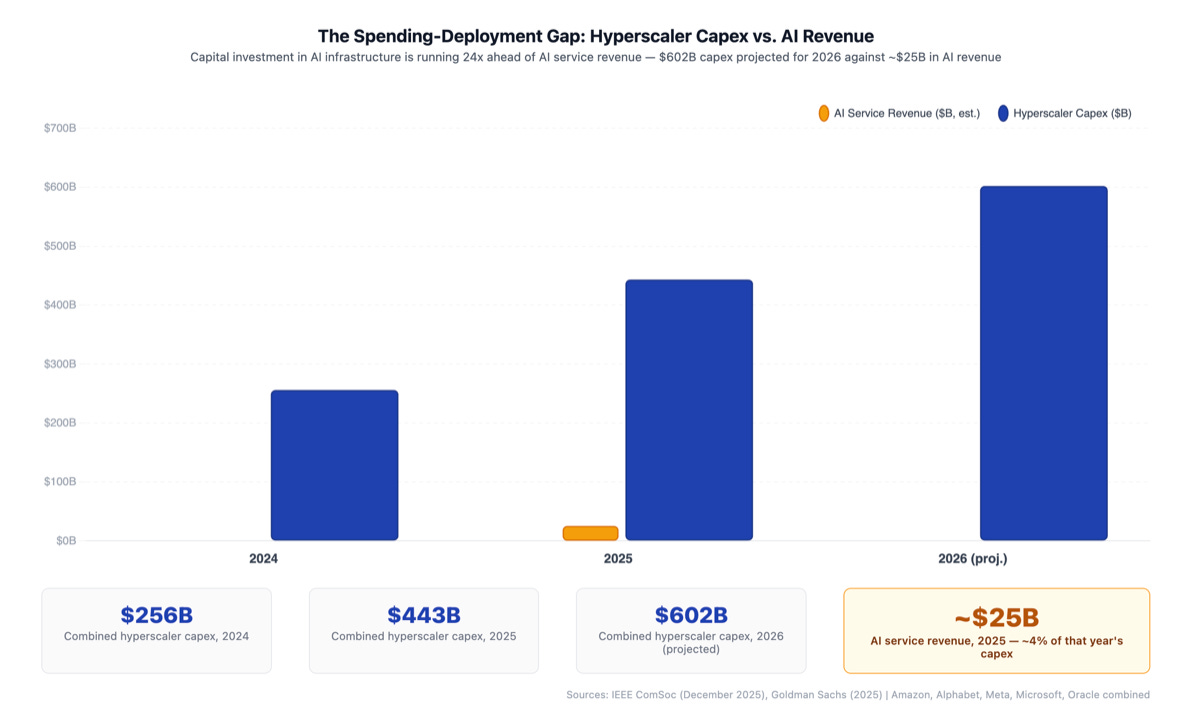
As Avanza analyzed in detail in the $640 Billion Gold Rush, this spending wave has no historical parallel. But a critical ratio has emerged that the market is beginning to price: AI services generated only approximately $25 billion in revenue in 2025 — roughly 10% of the infrastructure spend supporting it.9 Goldman Sachs found that only 25% of AI initiatives delivered expected return on investment, with fewer than 20% scaling across entire enterprises.9
The hyperscalers are spending ahead of revenue by design, betting on a demand curve that hasn’t arrived yet. Q4 2025 revealed that even this level of capital cannot overcome the physical constraint. You cannot buy your way out of a seven-year interconnection queue.
The result is a market bifurcated around a single variable: power access. Developers with sites that can receive grid connection within 18 to 36 months are operating in a seller’s market.14 Everyone else is managing a pipeline that may never convert to operating capacity on its announced timeline.
Bain & Company characterizes this as the industry’s transition from “scramble to strategy” — from aggressive pipeline expansion to disciplined execution against power availability.6 Cushman & Wakefield calls it “managed growth” — infrastructure-aligned expansion rather than speculative land banking.7 Wood Mackenzie frames it as “maturation” — execution replacing pipeline growth as the primary competitive metric.1
The framing differs. The underlying dynamic is identical: the grid has become the gatekeeper, and every other factor in data center development now runs downstream of power.
The Great Reshuffling: Which Markets Are Winning
The construction decline in primary markets is not evenly distributed — and understanding the geography of this constraint is where the investment thesis gets specific.
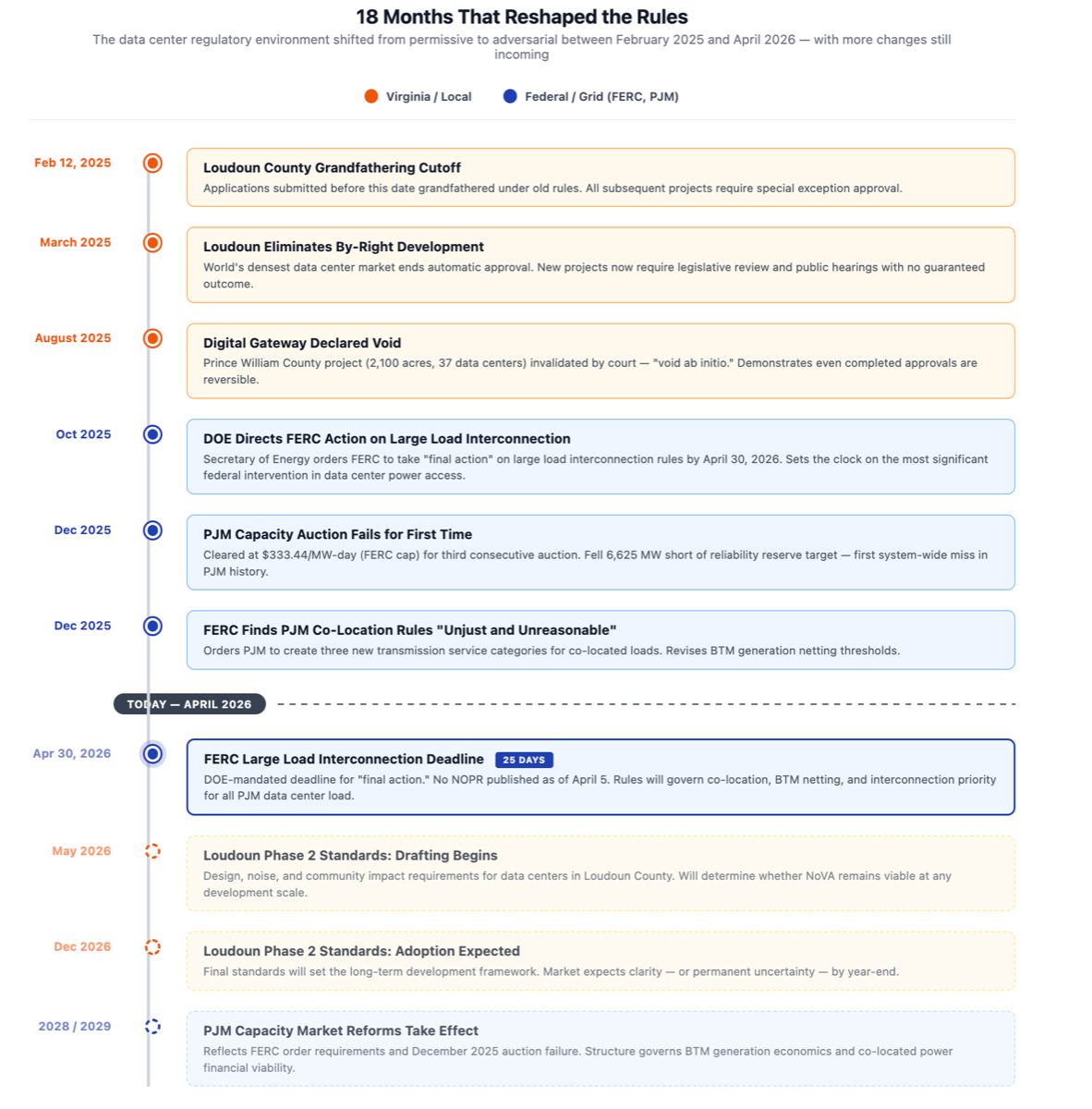
Northern Virginia, still the world’s largest data center market, led demand at 1,102 MW of net absorption in 2025 — but saw under-construction capacity fall 29% year-over-year.4 Supply is compressing even as demand intensifies. The combination of the seven-year interconnection queue at Dominion Energy13 and the local zoning overhaul discussed below has made new NoVA development a specialist play, not a volume play.
Hillsboro, Oregon saw under-construction decline 15%, driven by power procurement delays that have extended project timelines without yet resolving.4 Silicon Valley fell 14%, constrained by the compound challenge of land scarcity, elevated costs, and the same interconnection pressure affecting the broader Western grid.4
Against these declines, Dallas-Fort Worth stands out. Absorption surged to 470.8 MW, up 424 MW year-over-year — a near-vertical jump driven by Texas’s relative power availability compared to PJM and Pacific markets.4 Chicago posted 15.4% growth in the 10-MW-plus tier, benefiting from available large contiguous space and midcontinent grid infrastructure.4
The more significant story is what’s happening in markets that barely registered in previous cycles.
Secondary and Tertiary Markets: The New Frontier
The geographic shift accelerating in 2025 and 2026 runs on a simple calculation: sites in secondary and tertiary markets can receive power in 18 to 36 months. Constrained primary markets now require five to seven years. For AI training workloads — which generate revenue only when the compute is actually running — that difference is existential.
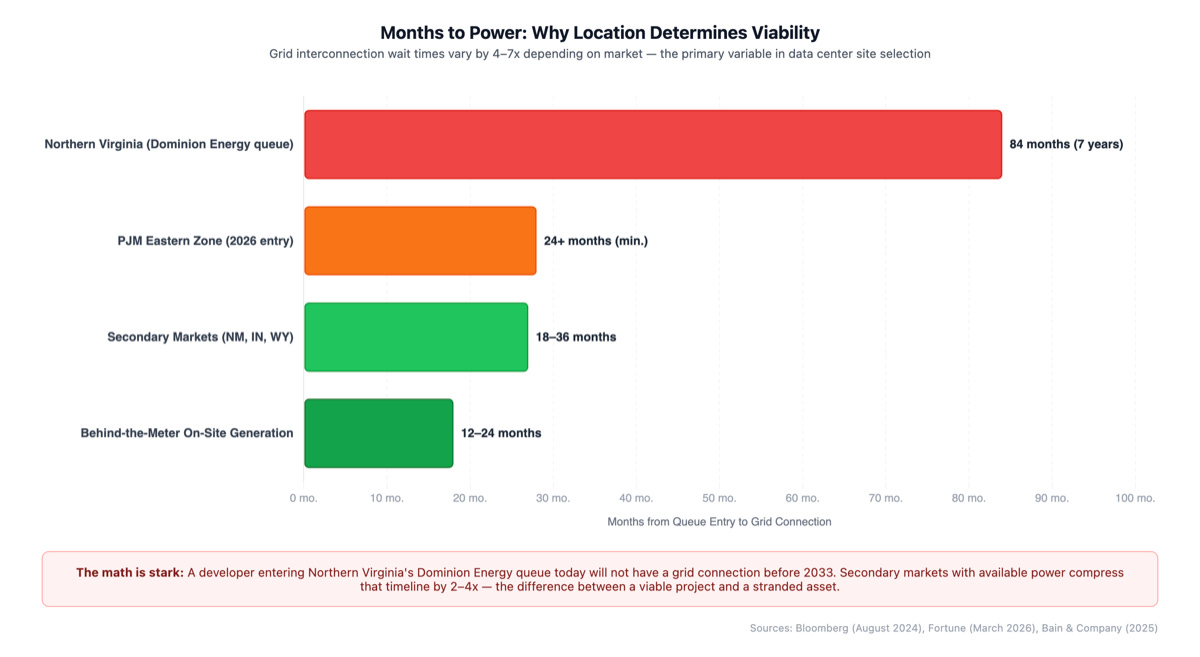
New Mexico recorded the greatest proportional growth of any market in Q4 2025, driven primarily by a massive project from New Era Energy & Digital in Lea County.1 The state’s combination of natural gas pipeline access, available land, and permitting environment has made it a sudden priority for developers unable to wait out NoVA’s queue. The Lea County project is speculative at scale — but it reflects a rational bet on where the path of least resistance lies.
Indiana has emerged as a significant beneficiary, with proportional pipeline growth driven by direct gas access and a regulatory environment that has not replicated Virginia’s local revolt.1 The state’s midcontinent grid position delivers reasonable interconnection timelines relative to PJM’s eastern congestion zones.
Wyoming is attracting interest for greenfield campuses at scales that primary markets can no longer accommodate.1 Initial phases are only beginning to develop, but the combination of available land, gas access, and cool climate for free-air cooling makes it a logical candidate for the next wave of AI training infrastructure.
Abilene, Texas deserves specific attention. The Oracle/OpenAI Stargate project — combining natural gas generation with fuel cells, targeting 200 MW or more per building and scaling to over 1 GW — is a proof of concept for what AI training campuses look like outside traditional markets.4 Texas’s zero-carbon-compliance cost environment is a compounding factor in that calculus: as Avanza documented in The $210 Million Carbon Arbitrage, the carbon compliance cost differential between Texas and California reaches $43.5 million per year per 500 MW facility — and that spread widens as California’s cap-and-trade escalates. CBRE projects that Reno and Abilene pipelines could exceed Hillsboro and Silicon Valley in 2026 development activity.4
Cushman & Wakefield’s February 2026 analysis identifies Indianapolis, Kansas City, and the Carolinas as gaining meaningful hyperscale attention.7 Austin-San Antonio, Denver, Salt Lake City, and Seattle appear on secondary shortlists.15 Central Washington and Iowa are beginning to surface on tertiary site-selection matrices.15
The full analysis continues below for paid subscribers, including the technical enabler driving AI campuses to remote locations, economic implications and cost structure evolution, the regulatory landscape reshaping the industry in Virginia and at FERC, the midstream gas opportunity, and strategic recommendations for investors and developers.
