


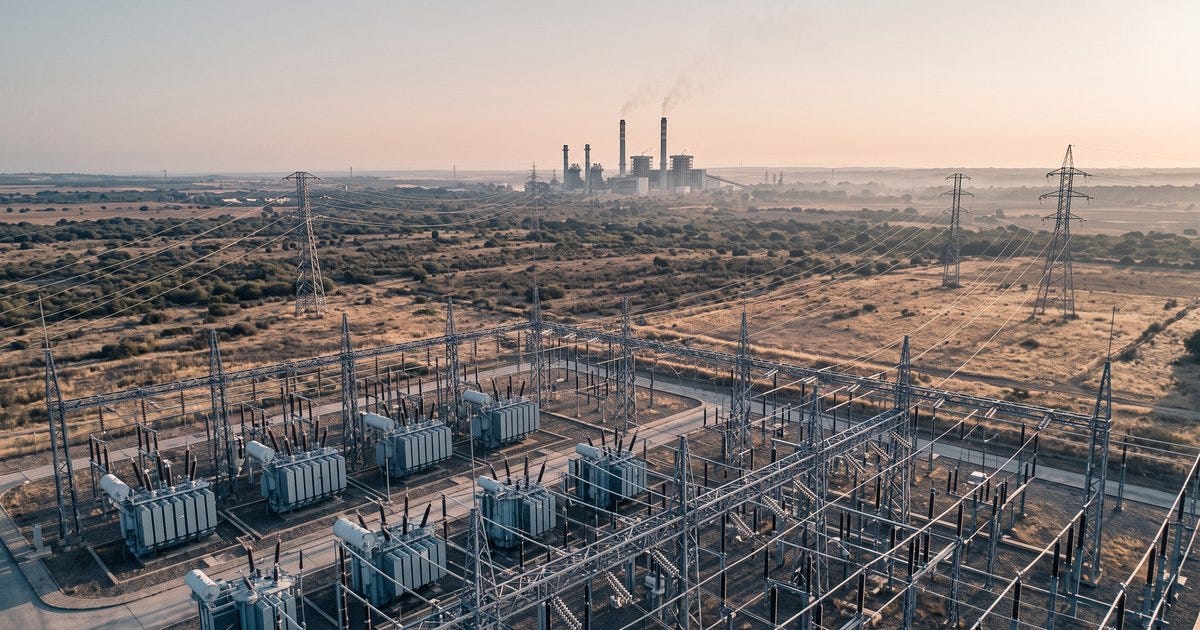
On 28 April 2025, at 12:33 in the afternoon, the power systems of continental Spain and Portugal went dark. Automatic protections tried and failed to arrest a runaway voltage swing, and within about two seconds grid operators shed roughly 31 gigawatts of demand: Spain's 25.1 and Portugal's 5.9.¹ Tens of millions of people lost power for more than eight hours.² ENTSO-E's own investigators, who spent nearly a year reconstructing what happened, called it the most severe blackout on the European power system in more than two decades, and the first of its kind.³ The event should have forced one question onto every grid operator's desk: how do you actually run a modern grid this dependent on wind and solar without this happening again?
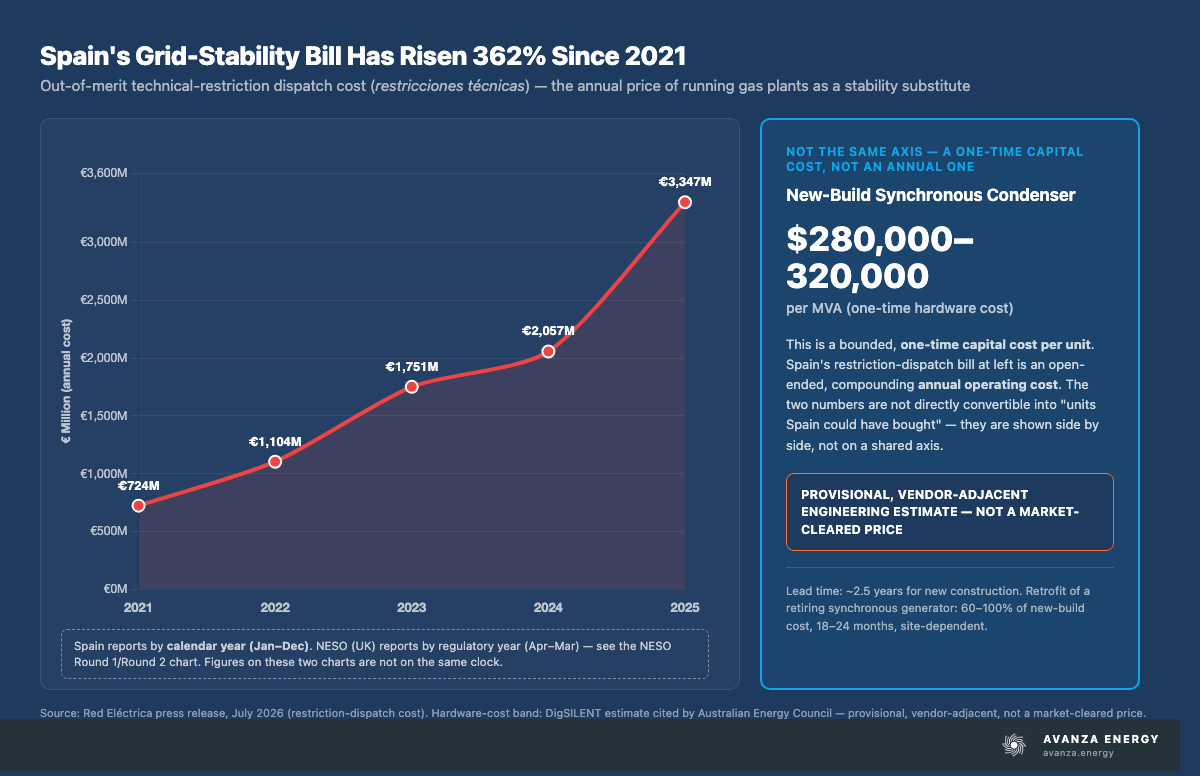
More than a year on, Spain's answer is on the invoice, not on the grid. Red Eléctrica paid gas plants €3.35 billion in 2025 to hold the voltage and inertia that collapsed that April afternoon, a bill that has risen 362% since 2021 and shows no sign of leveling off.⁴ In the same year, Spain curtailed 3.6 terawatt-hours of renewable generation, up 110% year on year: cheap, already-built wind and solar power thrown away because the grid cannot absorb it and nothing has been installed that would let it.⁵ The technology to fix the underlying problem is not experimental. Synchronous condensers are century-old rotating machines. Static synchronous compensators, known as STATCOMs, are commercially mature power-electronic devices. Grid-forming batteries have already been delivering the same service at transmission scale in Scotland since early 2025. None of these three technologies is unproven. All three are, functionally, absent from mainland Spain's grid.
That absence is not an accident of timing or an oversight waiting on the next capital cycle. It is written into the design of the one instrument Spain built to pay for grid hardware at scale. Spain's new €9 billion capacity market can only buy firm megawatts of generation. A synchronous condenser produces zero megawatts of active power; it exists purely to hold voltage, inertia, and fault-current strength. That makes it categorically ineligible to compete for that money, not merely uncompetitive against gas.⁶ Spain isn't failing to buy the fix. Spain built a market that cannot buy the fix, and is now paying gas plants a structural, growing premium to substitute for it.
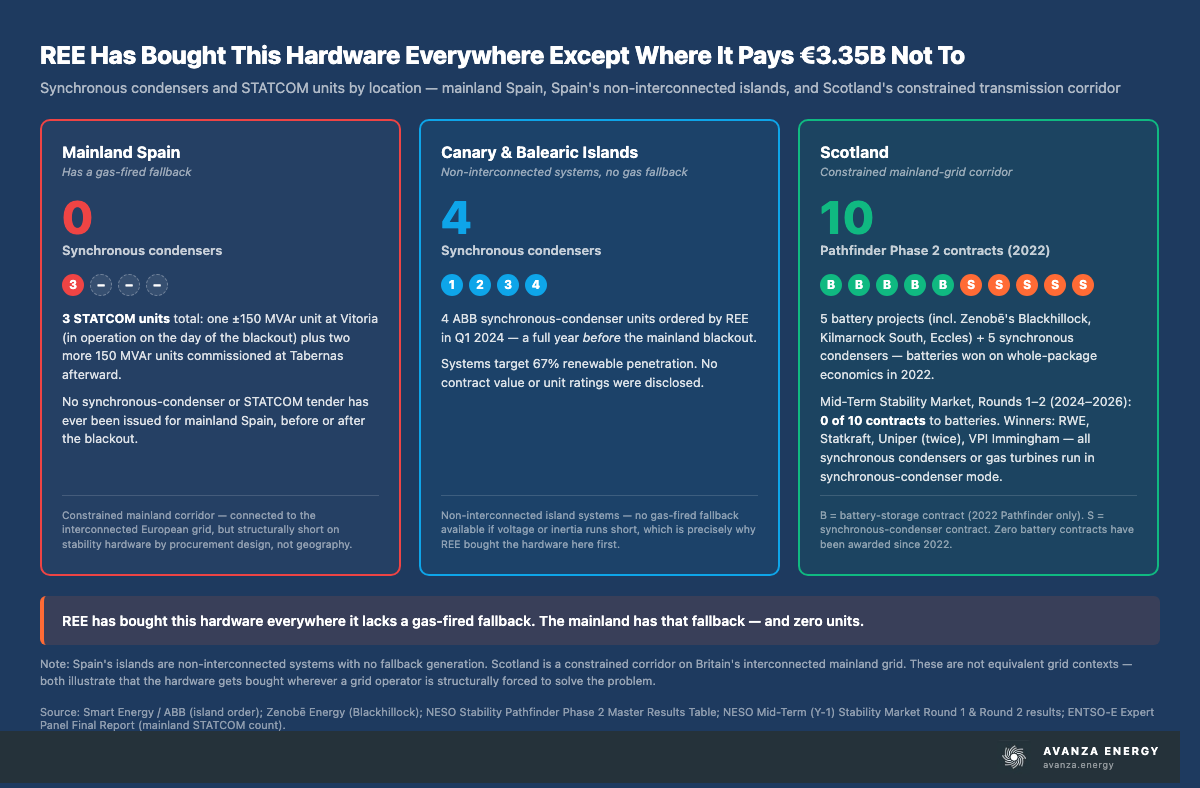
This piece is not another call to "buy the hardware." Every serious outlet that covered last year's Iberian blackout has said that already. The argument here is narrower and more useful: the binding constraint is procurement design, not technology readiness. That constraint shows up in mirror-image form on the other side of the continent. The United Kingdom built a stability market explicitly designed to be technology-open. Across two full tender rounds, it has still awarded grid-forming batteries zero contracts.⁷ Spain's market is closed by design. Britain's is open by design and unaudited in outcome. Both have produced the same result: real hardware, sitting on the sidelines of a real problem, because nobody wrote the rules to buy it.
The bill that stopped being a blackout story
The number to hold onto is restricciones técnicas: Spain's out-of-merit technical-restriction dispatch, the mechanism REE uses when it has to override the day-ahead market and order specific plants to run, purely to hold the grid steady. REE's own five-year series shows this line item rising from €724 million in 2021 to €1.1 billion in 2022, €1.75 billion in 2023, €2.06 billion in 2024, and €3.35 billion in 2025: a 362% increase that has made it the fastest-growing, now-dominant component of Spain's total balancing costs.⁴ The premium REE pays for this real-time intervention over the normal day-ahead price was 248.1 €/MWh against a 67.60 €/MWh day-ahead average in 2025, a 3.67x markup that was essentially unchanged from 2024's 238.5 €/MWh.⁸ That flatness matters more than the headline growth rate. A one-time blackout-response spike would fade. A stable, multi-year premium is a system that has quietly adopted this workaround as its permanent operating mode.
Britain's version of the same story, read correctly, is just as structural. But only if you use the right calendar. The National Energy System Operator (NESO), Britain's grid operator, reports in regulatory years running April to March, not the calendar-year figures that circulate in trade coverage. On NESO's own basis, total balancing costs reached £2.7 billion in the 2024/25 regulatory year, up 10% from £2.5 billion the year before, on a 17% rise in balancing-action volume. Thermal constraint costs specifically were £1.7 billion, up 64%, on 13.5 terawatt-hours of constrained volume, up 81%. NESO attributes the jump partly to planned Scottish network outages colliding with high wind output, and explicitly links the underlying pressure to "increasing need... to manage voltage and stability requirements" as synchronous generation retires from the system.⁹ That is Britain's grid operator naming, in its own annual report, the same structural gap Spain is papering over with gas.
The two countries are not investing at comparable scale to close that gap. The UK has unlocked £28 billion in transmission investment under Ofgem's RIIO-T3 price-control framework (80 projects from 2026 onward¹⁰), on top of ScottishPower's own £12 billion commitment to central and southern Scotland's grid through 2031.¹¹ Spain's proposed 2025-2030 grid investment package is €13.6 billion, with roughly three-quarters earmarked for grid strengthening.¹² This isn't a story about the UK simply buying different equipment. It is investing at a materially larger scale relative to system size, a gap worth naming rather than smoothing over, because it shapes how much room either country has to fix its stability procurement even after it fixes the paperwork. That capital scale isn't neutral: as Avanza has documented in the electricity rate paradox, tariff-funded grid investment carries its own structural bias toward more capex, not necessarily the cheapest fix.
Spain already proved the hardware works. It just didn't buy it for the mainland.
Here is the detail that makes Spain's failure indefensible rather than merely unfortunate: Red Eléctrica has already bought synchronous condensers. In the first quarter of 2024 (a full year before the blackout), REE ordered four ABB synchronous-condenser units for the Canary and Balearic Islands, non-interconnected systems targeting 67% renewable penetration.¹³ No contract value or unit ratings were ever disclosed.¹⁴ But the fact of the order settles an argument before it starts: REE knows this technology works, trusts it enough to deploy it on its own initiative, and did so specifically because an islanded grid has no gas-fired fallback when voltage and inertia run short. The mainland has that fallback. So the mainland has gas plants doing a job REE's own engineers have already validated purpose-built machines can do, everywhere except where the €3.35 billion bill is actually being paid.
Scotland offers the same proof from the other technology family. Zenobē's Blackhillock battery (300 megawatts and 600 megawatt-hours, sited deliberately between Inverness and Aberdeen to relieve congestion from three offshore wind farms) became the world's first transmission-connected battery delivering full active and reactive stability services to a grid operator.¹⁵ It is not a demonstration project. It is a commercial asset, built by a private developer, competing for and winning a regulated stability contract. Grid-forming batteries, synchronous condensers, STATCOMs: none of this is a research question anymore. It is a procurement question, and it is the question both Spain and the UK are getting wrong in opposite ways: Spain by writing hardware categorically out of its capacity market, and Britain, as the next section shows, by writing a technology-open tender that has never actually cleared a battery.⁷
Put a rough price on the gap and the case sharpens further. A new-build synchronous condenser runs roughly $280,000 to $320,000 per megavolt-ampere on the most defensible public engineering estimate available — a figure its own source flags as provisional, but the only anchor anyone has published.¹⁶ That is a bounded, one-time capital cost. Spain's €3.35 billion technical-restriction bill for 2025 is an open-ended, compounding operating cost that recurs every year the workaround stays in place and grows as the underlying grid gets harder to balance. Financing the machines once against paying the gas premium indefinitely isn't a close call on the economics. It's a closed case that a procurement rule has made impossible to act on. It's the same bounded-capex-versus-open-ended-cost logic Avanza found favoring battery deployment over multi-year interconnection queues in the US.
None of this is a Spain-specific failing, which is exactly why it's worth treating as a design problem rather than a national embarrassment. Britain built the more sophisticated instrument, deliberately engineered to be open to exactly the technology Spain has excluded, and it has still produced a result nobody at the operator or its regulator has adequately explained. A third path is already live and worth watching in real time: Germany's market-based inertia auction, running since January 2026, prices this same category of service openly rather than assuming it away or defining it out of eligibility. Whether that structure holds up once it runs multiple rounds, the way Britain's has now run two, is the open question the rest of this analysis takes seriously rather than answering in advance. That is the actual subject of what follows: not which country is furthest behind, but what a procurement design that actually works would need to look like.
The timing is not incidental. Every relevant procurement track examined here is live at the same moment: Spain's capacity market is about to run its first auctions, its modernized stability-compensation rules are only weeks old, Britain is midway through a third tender round on the back of two that produced zero battery contracts, and Germany's inertia market is barely a year into its first contract period. None of the four has a multi-round track record yet. Whichever jurisdiction gets the procurement design right first (not the biggest, not the earliest, but the first to actually price inertia, fault current, and voltage support as unbundled, technology-open products and defend that outcome under scrutiny) sets the reference terms the rest of the industry will build around.
The full analysis continues below for paid subscribers, including detailed economic analysis, competitive landscape assessment, regulatory implications, and strategic recommendations with comprehensive citations.
