

Virtual Power Plants (full report): The $10 Billion Opportunity Reshaping America's Grid Through Energy Storage
Our deep dive analysis of the VPP market for energy storage

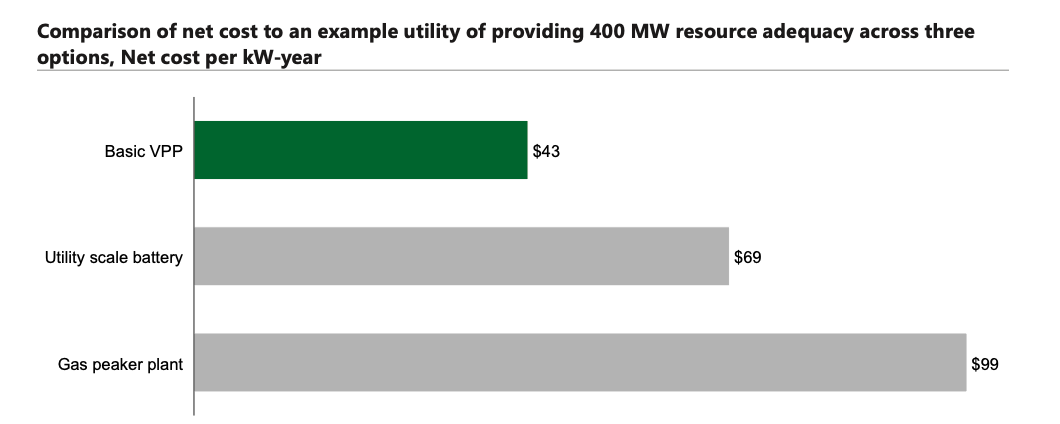
The energy storage revolution isn't coming—it's here, and battery-based virtual power plants are its most powerful catalyst. With 30-60 GW of total VPP capacity deployed across America, energy storage VPPs are proving they can transform our grid while slashing costs by 40-80% compared to traditional infrastructure. Yet we've barely scratched the surface: only 19.5% of distributed energy resources are enrolled in VPP programs today, and battery participation remains even lower.
This isn't just another technology trend. It's a fundamental shift in how we think about, build, and operate our electricity system—with energy storage at its core. And for those of us building the decarbonized future, the window to shape this transformation is now.

The Economic Reality Check: Why Battery-Based DERs Are Winning
Let's start with what matters most to utilities and regulators: money. The data is unequivocal—distributed energy resources, particularly battery storage systems, deliver distribution capacity expansion at 40-80% lower costs than traditional grid infrastructure.
Take California's massive EV adoption challenge. Studies show 67% of feeders will need upgrades by 2045, requiring 25 GW of additional capacity [1]. The traditional approach? $6-50 billion in grid investments. The battery storage alternative? A fraction of that cost with multiple revenue streams and modular deployment that actually matches real demand growth.
The Brooklyn-Queens Demand Management program remains the gold standard example. By investing $200 million in DER solutions—including battery storage alongside demand response—instead of $1 billion in traditional infrastructure, they achieved an 80% cost reduction [2] while delivering superior reliability outcomes. This isn't theoretical—it's proven, scaled, and replicable.
When Southern California Edison evaluates battery storage against traditional upgrades valued at $168.5 million [3], the storage solutions consistently achieve 20-80% cost savings. A recent analysis shows utility-owned storage combined with customer DERs results in 40% reduction in operating costs over 20 years [4].
Variations in VPP Types and How Energy Storage Changes Everything
Not all VPPs are created equal. While demand response programs using smart thermostats paved the way, battery-based VPPs represent a quantum leap in capability:
Traditional Demand Response VPPs (non-storage):
Smart thermostats, water heaters, pool pumps
One-way power flow (load reduction only)
Limited duration (2-4 hours maximum)
Single service capability (peak shaving)
Example: Arizona Public Service's 145 MW from 83,000+ thermostats [5]
Battery-Based VPPs (our focus):
Residential and C&I battery systems (with or without solar)
Bidirectional power flow (charge and discharge)
Flexible duration based on battery size
Multiple service capability (capacity, energy, ancillary services, backup power)
Example: Green Mountain Power's 50 MW from 4,800+ home batteries [6]
The distinction matters because batteries provide fundamentally different value. While a smart thermostat can reduce load for a few hours on hot days, a battery can discharge during peaks, charge during renewable oversupply, provide frequency regulation in milliseconds, and keep homes powered during outages.
FERC Order 2222: A Case Study in Regulatory Theater
FERC 2222 was meant to give distributed assets a meaningful way to participate in wholesale electricity markets. But let's be honest about FERC Order 2222's implementation—it's been a masterclass in malicious compliance. CAISO's November 2024 rollout perfectly exemplifies how ISOs can technically follow federal orders while ensuring nothing actually changes.
CAISO did the bare minimum [7]:
Reduced participation thresholds? Yes, to 100 kW—still excluding most residential systems
Created new participation models? Sure, with poison pills like 24/7 availability requirements
Enabled heterogeneous aggregations? Technically, but with restrictions that make them unviable
CAISO designed a participation model that is worse than what was already available under Demand Response programs. By maintaining the 24/7 settlement requirement, demanding resource-level metering ($1,000-3,000 per residential site), and limiting aggregations to single sub-LAPs, they created a program that looks good on paper but is economically impossible for most battery operators.
