

The $350 Million Shortcut: Why Data Centers Are Ditching the Grid Instead of Waiting 7 Years for Power
Insights from PowerGen 2026 confirm the structural shift: utilities can't deliver megawatts fast enough, so hyperscalers are building their own power plants instead

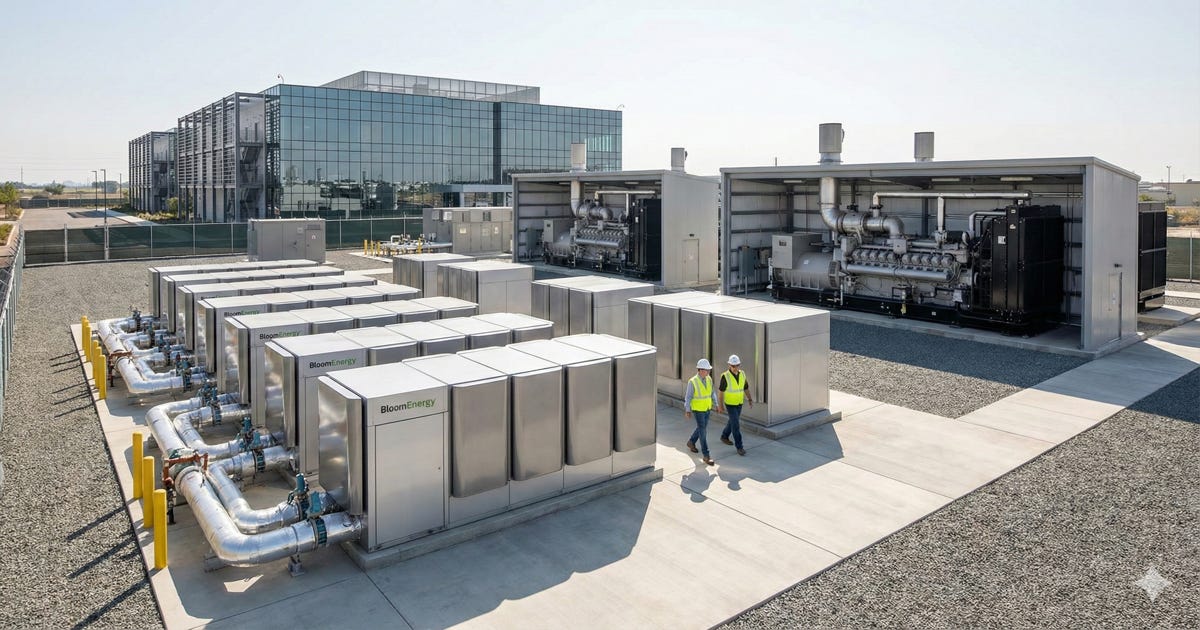
The electric utility business model just hit an existential challenge—and it’s being driven by the industry’s best customers. When American Electric Power announces partnerships to deploy 1,000 MW of behind-the-meter fuel cells for data centers,[^1] when Caterpillar books a 4,000 MW order for a single Utah facility,[^2] and when Meta builds 400 MW of dedicated natural gas generation that never touches the grid,[^3] you’re witnessing a fundamental restructuring of how critical infrastructure gets powered in America.
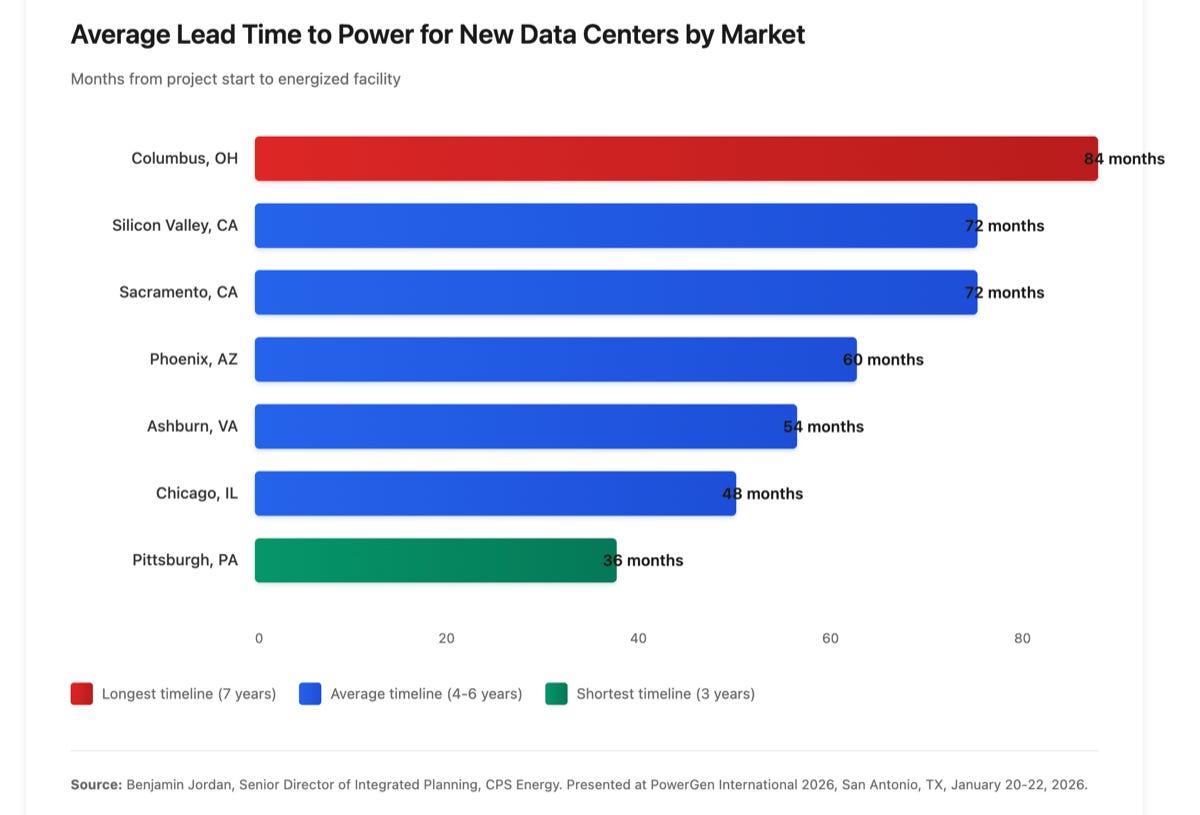
This isn’t a temporary response to supply chain constraints. It’s a structural shift driven by math that no longer works for either side. Utilities face 3-7 year interconnection timelines depending on market—84 months in Columbus, 72 months in Silicon Valley, 36 months at best in Pittsburgh.[^JORDAN] Data center operators compete in 12-18 month deployment cycles where a year of delay means losing a hyperscale contract or missing an AI model generation. Behind-the-meter generation solves the power delivery problem in 16-30 months depending on technology—fast enough to matter, cheap enough to justify, and increasingly, the only viable path forward.
Six months ago, Avanza reported on this $42 billion onsite generation market driven by AI data centers.[^5] PowerGen 2026 in San Antonio this week reveals something more significant: behind-the-meter isn’t becoming AN option for powering data centers. It’s becoming THE infrastructure model, with 25-35 GW of deployment projected through 2030 and continuing acceleration toward 2035.[^6]
The Timeline Gap That Broke the Grid Model
The numbers tell a brutal story. In 2007, a large industrial customer could request grid interconnection and be operational in under two years. By 2015, that timeline stretched to three years. Today, regional variation is extreme: Columbus, Ohio faces 84-month (7-year) interconnection timelines for new data centers—the worst among major markets. Silicon Valley, Sacramento, and Portland require 72 months (6 years). Phoenix and Atlanta: 60 months (5 years). Even the best markets—Pittsburgh, Chicago, Houston, Dallas—need 36 months (3 years).[^JORDAN]
No major data center market can deliver grid power in under three years. Most need five to seven.
The timeline crisis compounds as data center scale expectations accelerate. In just 15 months, typical hyperscale project size jumped from 100-300 MW to at least 1 GW according to Gene Alessandrini, CyrusOne’s SVP of Energy and Location Strategy.[^ALESSANDRINI] Utilities designed interconnection processes for 50-100 MW industrial loads, not gigawatt-scale computing campuses that rival baseload power plants. The grid planning cycle cannot keep pace with AI infrastructure ambitions measured in months, not years.
Data centers consumed 176 TWh of U.S. electricity in 2023—triple the 2014 level. By 2028, demand will hit 325-580 TWh, representing 6.7-12% of total U.S. electricity consumption.[^7] That’s equivalent to adding 100 GW of new peak capacity by 2035, with at least 50 GW attributable to data centers alone.[^7]
The grid can’t keep up. The scale of the bottleneck defies comprehension: interconnection queues across U.S. grid operators now hold approximately 2,290 GW of generation and storage projects awaiting connection—nearly twice the entire installed capacity of the U.S. power plant fleet at 1,320 GW.[^JORDAN] In MISO, queued capacity is 4.9 times installed capacity. In ERCOT, it’s 4.2 times. In PJM, 643 GW waits in queue against just 142 GW of installed capacity.[^JORDAN]
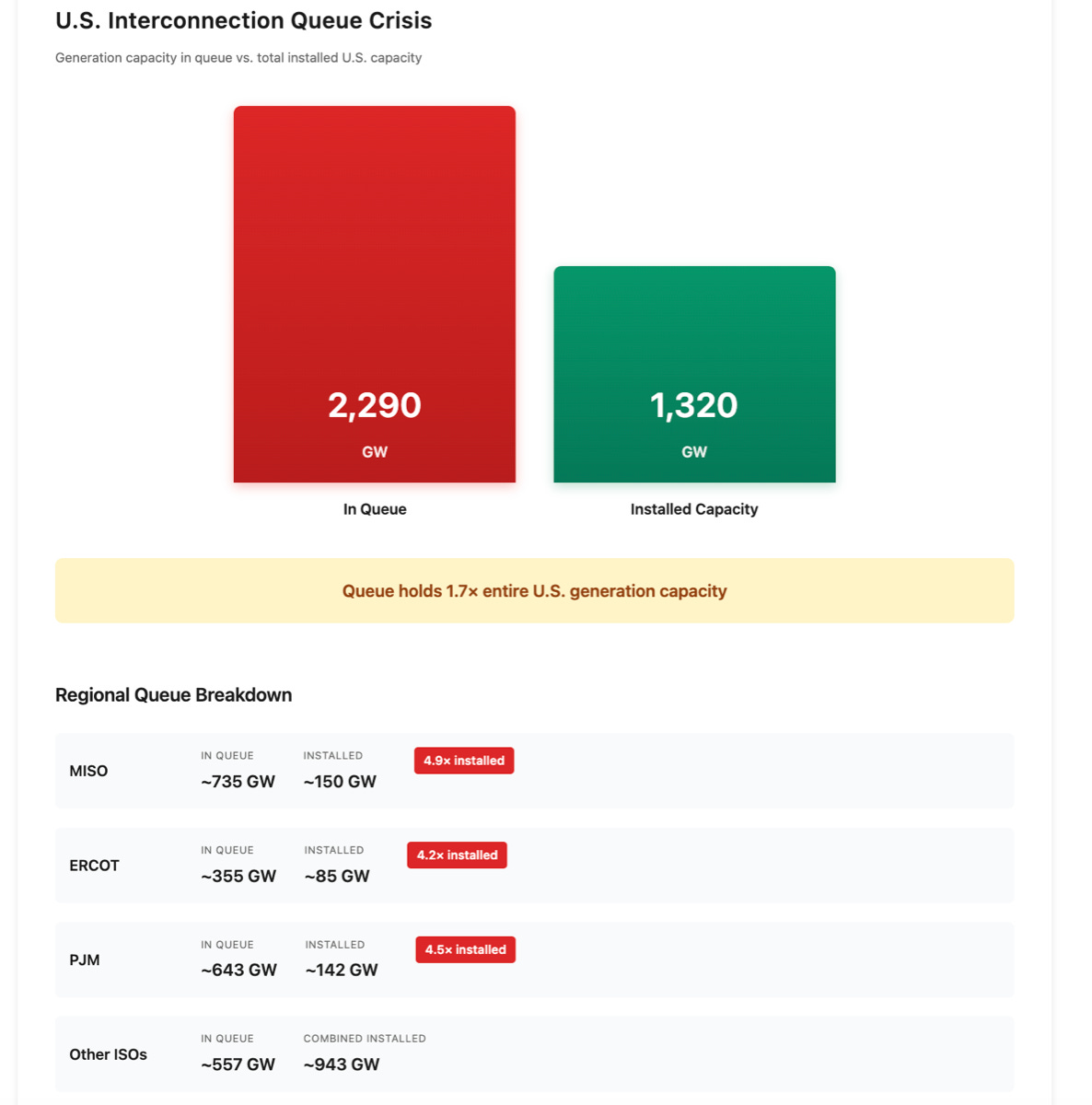
Even if utilities could process these requests instantly, the physical grid cannot absorb double its current generation capacity without years of transmission upgrades. PJM alone has processed over 170,000 MW of new generation interconnection requests since 2023.[^8] Even with FERC’s directive for final rules on large-load interconnection by April 30, 2026,[^9] implementation won’t arrive until 2027-2028 at earliest—and the best-case scenario remains 3-5 years for grid connection. Data center competitive timelines cannot accommodate a three-to-seven-year power delivery delay.
The economic pressure compounds the timeline problem. PJM capacity market prices tell the story: $28.92/MW-day in 2024/25, then $269.92/MW-day in 2025/26—a nine-fold increase—and now $329.17/MW-day for 2026/27.[^10] For a 100 MW data center, that’s $12 million annually in capacity charges alone, before consuming a single kilowatt-hour. Data centers drove 63% of that price increase, adding $9.3 billion in costs across PJM.[^10]
The paradox sharpens: utilities need massive grid investments to serve data center load growth, which drives capacity prices higher, which makes behind-the-meter economics increasingly compelling, which accelerates grid defection. Virginia ratepayers face projected residential bill increases from ~$159/month today to $381/month by 2040 if data centers don’t bear infrastructure costs directly—that’s $222/month or $2,664 annually in added costs that’s already generating political backlash.[^11] Meanwhile, data centers that maintain grid connections are discovering they can transform from passive consumers into revenue-generating assets through load flexibility programs—creating another pathway that reduces rather than increases pressure on utility customers.
The Fast-Deploy Alternative: 16 Months Instead of 7 Years
Behind-the-meter generation breaks the timeline bottleneck—though not as dramatically as early marketing claimed. Bloom Energy’s solid oxide fuel cells, once marketed with 90-day deployment timelines, now require 16-18 months for delivery, installation, and commissioning of 50+ MW installations according to current industry estimates.[^JORDAN][^12] Mainspring Energy’s linear generators face similar timelines at 16-18 months for large-scale deployments.[^JORDAN][^14]
Even at 16-18 months, that’s 18 to 66 months faster than grid interconnection depending on market. In Columbus, Ohio—where grid access takes 84 months—behind-the-meter fuel cells deliver power in one-fifth the time. Speed still matters decisively, even if “90 days” was never realistic at scale.
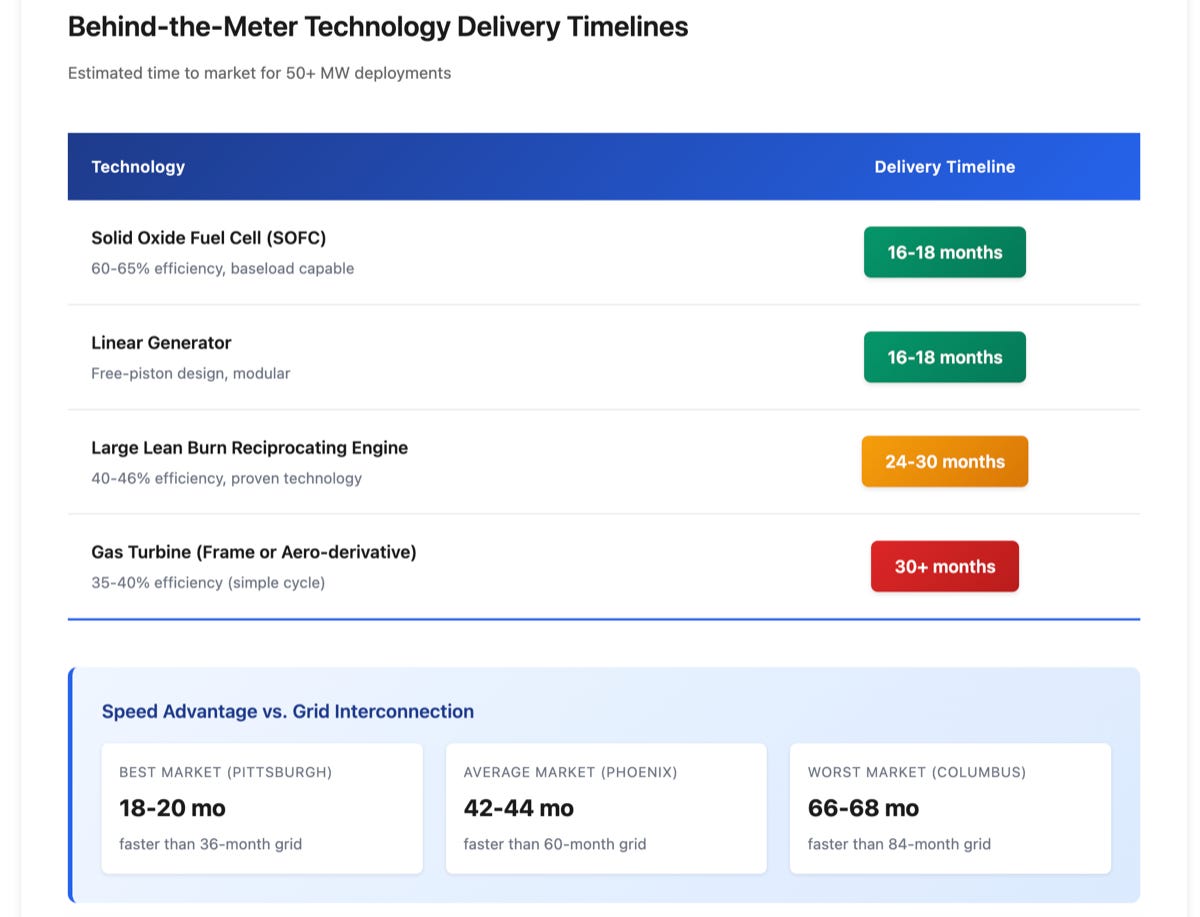
The technology delivers. Bloom’s fuel cells achieve 60-65% fuel-to-electricity efficiency on natural gas—among the highest conversion rates available.[^13] At 100 MW per acre power density when stacked vertically, the technology fits data center footprints while delivering 99.9-99.999% uptime targets.[^12] This power density advantage is significant: reciprocating engines and gas turbines deliver approximately 50 MW per acre,[^26] while aeroderivative turbines like the GE LM2500 achieve roughly 72-86 MW per acre in multi-unit configurations.[^27] Fuel cells’ compact footprint—achieved through vertical stacking to four units high—makes them particularly valuable for space-constrained urban data center sites. Many operators pair fuel cells with battery storage systems to manage the 40%+ load swings from AI training workloads while maintaining baseload generation.
Bloom isn’t alone, but supply is universally constrained. Even at 2 GW annual production capacity by end-2026, Bloom can only deliver 2 GW per year against a market demanding 5-7 GW annually through 2030.[^12] The company’s stock surged 400% over the past year as hyperscalers including Equinix (100+ MW deployed), Oracle, AWS (via AEP partnerships), and Coreweave commit to the technology.[^12] First movers secure supply. Later entrants face allocation decisions and extended lead times.
Reciprocating engines provide another path—but face even worse supply constraints. Caterpillar’s 4 GW Utah project uses Cat G3520K HR (High Response) generator sets delivering 2.5 MW per unit. The G3520K HR can start, take on full load, and sync to the grid in 4.5 minutes—significantly faster than previous-generation models (6 minutes) but still slower than specialized fast-start configurations that achieve full power in 30-60 seconds when preheated.[^2][^28] The first gigawatt goes operational in 2026.
But there’s a catch: Caterpillar’s order backlog now extends 24 months minimum—and that’s with a major production facility coming online in early 2026 that will double manufacturing capacity.[^CAT-VERBAL] Even with twice the production, Caterpillar is sold out through 2027. Orders placed in Q1 2026 won’t deliver until 2028, putting large reciprocating engines in the 24-30 month delivery window and eliminating their historical speed advantage over gas turbines.[^JORDAN][^15]
Jenbacher (INNIO Group) faces similar constraints, though the privately-held company discloses less data. The company’s J620 units deliver 3.3 MW with sub-45-second startup and efficiency up to 46%, but volume availability remains constrained.[^5]
Smaller manufacturers like 2G Energy exploit a critical advantage: availability. While Caterpillar and Jenbacher face 24-30 month backlogs for large lean-burn generators, 2G’s less-constrained order book enables sub-12-month delivery across multiple product lines—with many smaller units (<2.5 MW) available even faster.[^2G-VERBAL] The trade-off is scale: achieving 100 MW requires more units and potentially more complex site integration than Caterpillar’s 2.5 MW or Jenbacher’s 3.3 MW engines. But for mid-size developers locked out of hyperscaler-dominated allocation at major OEMs, or for multi-phased deployments where 10-20 MW increments make sense, 2G offers what matters most: delivery this year instead of 2028.
EdgeConnex is taking the model to its logical conclusion: purely off-grid data centers. The company plans 120 MW and 200 MW gas-fired power plants for Ohio facilities with no grid connection whatsoever.[^16] Meta’s Ohio Socrates facility follows similar logic—200 MW of natural gas generation operational November 2026, with an additional 200 MW in H2 2026, dedicated to the data center, not grid-connected.[^3] When Williams Companies operates your power plant and five different engine types populate your generation fleet because supply chain constraints force mix-and-match sourcing,[^17] you know the behind-the-meter market has moved from niche to mainstream.
The economics of off-grid versus grid-connected behind-the-meter approach parity according to colocation industry sources with off-grid deployment experience, with numerous project-specific factors influencing the final calculation. But the strategic driver isn’t cost optimization—it’s speed to market. When Columbus faces 84-month grid timelines, eliminating grid interconnection entirely removes a seven-year obstacle.[^JORDAN]
The full analysis continues below for paid subscribers, including detailed economic analysis showing when BTM beats grid costs, competitive technology landscape with efficiency comparisons, strategic implications for different stakeholders, and the 2030-2035 transition path to clean baseload power.
